You Don't Have to Freeze in Iceland to See the Northern Lights
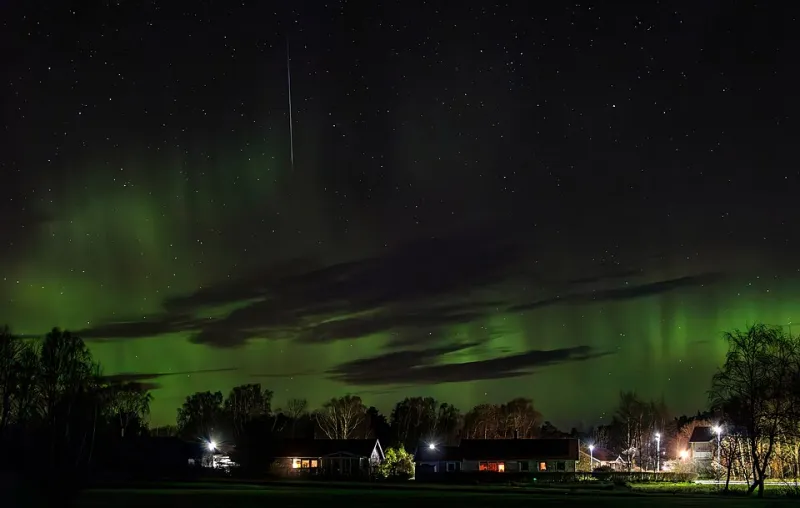
Photo: W.carter, CC BY-SA 4.0, via Wikimedia Commons
Let's be honest about something: chasing the Northern Lights in person is kind of a gamble. You book the flights, rent the cabin outside Reykjavik, pack enough thermal layers to survive a Mars mission — and then a cloud system rolls in and you spend three nights staring at gray sky. It happens to people all the time. Expensive, frustrating, and weirdly common.
The good news? You can now watch the aurora borealis dance across the sky in real time from your living room, with a reliability that no in-person trip can match. And that's just the beginning of what's become a surprisingly rich world of virtual celestial event watching.
How Real-Time Aurora Streaming Actually Works
Several organizations in Iceland, Norway, Alaska, and northern Canada have set up permanent, high-quality cameras pointed at the sky specifically to stream aurora activity. These aren't grainy webcam feeds — we're talking proper wide-angle cameras with low-light capabilities that often capture the lights more vividly than the human eye does in person.
The aurora borealis is caused by charged particles from the sun interacting with Earth's magnetic field, which means its appearance is tied to solar activity. That activity is trackable and forecastable, which is where things get really useful for virtual aurora hunters.
NOAA's Space Weather Prediction Center (swpc.noaa.gov) publishes aurora forecasts updated every 30 minutes. The key number to watch is the Kp index — a scale from 0 to 9 that measures geomagnetic activity. A Kp of 5 or higher typically means visible aurora in northern regions. A Kp of 7 or above? That's when you might see the lights stretching surprisingly far south, and the live streams really start to pop.
The Best Platforms for Watching Live
Once you know a strong aurora event is incoming, here's where to actually watch:
Explore.org has become something of a cult favorite in the virtual travel community. Their live aurora camera in Churchill, Manitoba, runs around the clock during aurora season and has a genuinely engaged community watching alongside you in the chat. There's something unexpectedly social about watching a natural light show with strangers from across the country.
The Aurora Service (aurora-service.eu) aggregates live camera feeds from multiple Nordic locations and pairs them with real-time Kp data, so you can watch the sky and the forecast simultaneously.
YouTube Live has also become a surprisingly solid source. Channels based in Tromsø, Norway, and Fairbanks, Alaska, regularly stream during peak aurora windows. Search "aurora live stream" and sort by live content — you'll often find multiple feeds running at once, which lets you hop between locations depending on cloud cover.
For Alaska-specific viewing, the Geophysical Institute at the University of Alaska Fairbanks (gi.alaska.edu) runs aurora forecasts tailored to North American audiences, which is especially handy if you want to frame the experience around something a little closer to home.
Beyond the Aurora: A Full Calendar of Virtual Sky Events
Once you get into the habit of watching the sky virtually, you start realizing how much is actually happening up there on a regular basis. The aurora is the headline act, but the supporting lineup is seriously underrated.
Meteor Showers The Perseids in August and the Leonids in November are the crowd favorites, but the Geminids in December are arguably the most active shower of the year and get far less attention. NASA's meteor shower page keeps a running calendar, and the Virtual Telescope Project (virtualtelescope.eu) livestreams major showers with expert commentary. It feels like a watch party — which, honestly, it kind of is.
Solar and Lunar Eclipses Eclipses are the celestial events most Americans have heard of, but actually catching one in person requires being in exactly the right geographic strip at exactly the right moment. Virtually, that limitation disappears. Time and Date (timeanddate.com) streams eclipses live with real-time maps showing the path of totality, and NASA TV covers major eclipses with multi-camera setups from locations around the world. The 2024 total solar eclipse generated some of the most-watched livestream content in recent memory — proof that people genuinely want to experience these things, even through a screen.
Planetary Conjunctions and Rare Alignments These are the events that casual sky-watchers often miss entirely because they're not on most people's radar. A planetary conjunction — when two or more planets appear unusually close together in the sky — can be strikingly beautiful and requires no special equipment to appreciate. Sky & Telescope (skyandtelescope.org) maintains an excellent upcoming events calendar, and their online community is welcoming to beginners.
The International Space Station This one's a little different but worth including. NASA's Spot the Station tool (spotthestation.nasa.gov) tells you exactly when the ISS will pass over your specific zip code, and you can often see it with the naked eye as a fast-moving bright dot. Pair that with a live stream from the station's external cameras via NASA TV, and you've got a surprisingly immersive experience — watching the station cross your sky while simultaneously seeing the view from inside it.
Setting Yourself Up for Success
Virtual sky-watching is low-effort to start but easy to optimize. A few things that make a real difference:
- Bookmark NOAA's Space Weather page and check it every few days. When a solar event is brewing, you'll want a heads-up.
- Use a second screen if you have one. Keep the live feed on your TV via Chromecast or Apple TV, and use your laptop or phone to follow along with real-time data.
- Turn the lights down. It sounds obvious, but watching a dark sky on a bright screen in a lit room kills the atmosphere. Lean into it — make it an event.
- Join a community. Reddit's r/Aurora and r/Astronomy are active, knowledgeable, and genuinely excited when big events happen. Following along with other enthusiasts makes the experience feel shared rather than solitary.
The Bigger Picture
There's a reason people travel thousands of miles and spend thousands of dollars to see the Northern Lights. It's one of those experiences that's supposed to make you feel small in the best possible way — a reminder that there are forces and phenomena operating on a scale that has nothing to do with your to-do list.
The virtual version of that feeling isn't identical. But it's more accessible, more reliable, and — when you're watching a Kp-8 aurora event light up a Norwegian fjord at 2 a.m. from your couch — genuinely, surprisingly moving.
The sky is always doing something worth watching. You just need to know where to look.