Window Seat, Zero Jet Lag: The Case for Virtual Train Rides
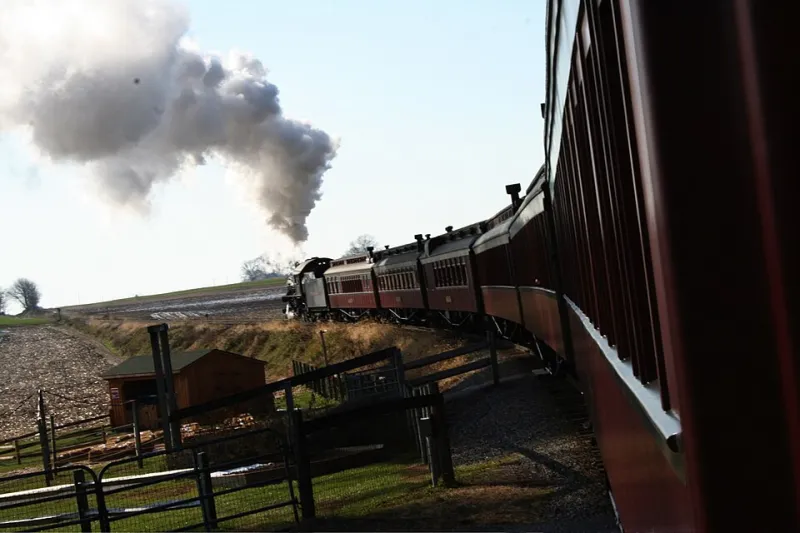
Photo: Stephen Howard, CC BY-SA 2.0, via Wikimedia Commons
There is a particular kind of travel video that does almost nothing. A train leaves a station in Norway. Snowy fields slide past. The camera does not cut. Nobody talks. Nobody sells you a suitcase. Forty minutes later, the train is still moving. This is slow TV, and as of late 2026, it has become one of the quietest success stories in virtual travel.
For homesick travelers, armchair explorers, and anyone who has ever stared at a departure board and felt their shoulders climb toward their ears, long-form rail footage is a strange little gift. It is travel without the airport. It is a window seat without the seatmate. It is a way to go somewhere while staying exactly where you are.
Why Slow Rail Is Having a Moment
Slow TV is not new. Norway's NRK famously aired a seven-hour cab ride along the Bergensbanen in 2009, and the format has been drifting around the internet ever since. What is new is how easily Americans can find it. YouTube is full of cab-view journeys, station-to-station recordings, and ambient rail videos. Live train cams show freight lines and commuter routes in real time. Streaming apps and smart TVs have made it easy to put a train window on the big screen and leave it there.
The appeal is not suspense. It is the opposite of suspense. A train journey has a beginning, a middle, and an end, but it does not demand that you react. There is no cliffhanger, no jump cut, no urgent soundtrack. Your nervous system gets to settle into the rhythm of the rails. For people who cannot travel easily, or who are missing a place they used to live, that rhythm can feel like a small homecoming.
It also works as background companionship. You can fold laundry while the Glacier Express crosses a viaduct. You can answer emails while a Japanese local line runs through rice fields. The train does not care. It keeps going. That is the whole point.
Six Routes Worth Riding From the Couch
Not all rail videos are created equal. The best ones give you a sense of place, not just a moving blur. Here are six routes to start with, each with a different flavor.
1. Norway's Bergensbanen. The original slow-TV classic is still the gold standard. You get a cab view across one of Europe's most dramatic plateaus, from forests to frozen tundra. Watch it in winter if you want the full blue-hour effect. The lack of narration is not a flaw; it is the invitation.
2. Switzerland's Bernina Express and Glacier Express. Swiss rail footage is almost unfairly beautiful. Stone viaducts, snow-covered peaks, tiny stations with red roofs. The Bernina route has a particularly satisfying mix of tight curves and alpine tunnels. Look for cab-view versions rather than highlight reels if you want the full slow experience.
3. India's Darjeeling Himalayan Railway and Konkan Railway. These are not quiet, exactly. They are alive. Horns, chatter, stations, and the clatter of a railway that feels like a moving neighborhood. The Darjeeling route offers misty mountain drama; the Konkan route brings coastal tunnels and green hills. Choose one depending on whether you want cozy or cinematic.
4. Japan's Shinkansen and local lines. Shinkansen cab views are clean, precise, and oddly soothing. For a slower mood, find footage of rural local lines where the train stops at tiny stations and the conductor announcements become part of the atmosphere. It is a very different kind of travel from the bullet-train blur.
5. Amtrak's California Zephyr and Empire Builder. For U.S. travelers, these are the home-team options. The California Zephyr runs through the Rockies and the Sierra Nevada; the Empire Builder crosses the northern Plains and the Pacific Northwest. Cab rides and rear-window videos are both available, and both give you a sense of the scale that airplane travel flattens.
6. Canada's Rocky Mountaineer and New Zealand's TranzAlpine. If you want scenery that looks like a screensaver in the best possible way, these are your routes. The Rocky Mountaineer footage is lush and golden; the TranzAlpine cuts through river valleys and mountain passes that feel almost invented. Pair either with a map so you know what you are looking at.
How to Build a Virtual Rail Day
A satisfying virtual train ride takes a little setup. First, pick a route and a time of day that matches your mood. A snowy Norwegian cab ride is a morning thing. An Indian coastal route feels better in the afternoon. A Swiss alpine journey pairs well with a rainy Sunday.
Next, decide how you will watch. A laptop is fine, but a TV or a large monitor makes the window feel more immersive. If you have headphones, use them. Train sound is half the experience: the click-clack, the announcements, the wind at the door. If you are sensitive to motion, choose a fixed forward-facing cab view rather than a handheld walking tour. You can also lower the playback speed slightly if the footage feels too fast.
Then build a small ritual. Make tea or coffee. Put out a snack that matches the region, or at least something you actually enjoy. Open a map on your phone or a second screen so you can follow the route. Turn off notifications. Give yourself permission to watch for 30 minutes without doing anything else. If you get restless, pause and come back. The train will wait.
For a longer session, plan a station break. Watch one route for 90 minutes, then switch to a different country or a different era of rail travel. Treat it like a connection. The change of scenery keeps the experience from turning into wallpaper.
The Fine Art of Doing Almost Nothing
Slow TV will not appeal to everyone. Some people will find it maddening. But for a certain kind of traveler, the lack of plot is the luxury. You do not have to plan a connection. You do not have to haul a suitcase up a platform. You do not have to worry about whether the train is on time. You just sit by the window and let the world go by at a speed your brain can actually handle.
That is not a lesser form of travel. It is a different one. And on a gray Tuesday when the bank account is thin and the passport is in a drawer, it might be exactly the trip you need.